Showing posts with label politics. Show all posts

2010-08-07

Juke, Jerk and the Rebel Archetype Inside Capitalism

I've been taught that it is a breach of netiquette to reproduce comments from Google Reader. So I'm not going to relate a conversation I read a couple of months ago between two scholars I respect a great deal, though the gist was that Los Angeles jerk music was just too commercial.

Oh, they didn't use that exact term, but I got the drift. They talked about "genre-brands" and "entering into the symbolic circuits of consumer capitalism", and if they didn't use the preposterous, worker-demeaning term "affective labour" it was probably by accident. Jerk (which I don't think either of them dislike, by the way) supposedly was close in the way it presented itself to the commercial end of capitalism, and contained a bunch of aspects that supposedly pegged it as particularly interested in selling itself. This in contrast with Chicago's juke/footwork music, held up as a relative anti-capitalist ideal by comparison.

Well, I beg to differ. Juke is also consistently wonderful music, but it certainly plays much closer to the capitalist rules, and is in many ways much more in line with a capitalist ideal. And I think calling it "consumer capitalist" is making jerk's quiet rebellion a great disservice.

What was the most successful capitalist music product online last year? Obviously, such a product's quality is to be measured in the only language that capitalism understands: sales. Thus the most capitalist product in downloadable media was, by a good distance, neither Lady Gaga nor the Black Eyed Peas but the extremely successful album Only by the Night by Kings of Leon. It's aesthetic is entirely in a supposedly non-capitalistic, "alternative" mode, with a hand-painted album cover, sullen-looking, black-clad album photos, and a sort of supposedly earnest rock music that's miles from Flo Rida.

The same relationship exists with juke and jerk. Jerk is spreading to poor communities as far away as panama, but juke is definitely the most promising capitalist product - it's got major backing from the hot and hip, and is apparently all over London right now. And yet, it is seen as less commercial! So, bizarrely, is dubstep, perhaps the single most successful new electronic music form of the last decade.

A classic Marxist/rockist explanation of the success of juke and Kings of Leon and dubstep would be the idea of selling out, or in Marxist parlance the "parasitic" nature of capitalism, latching onto non-capitalistic creative scenes. From my point of view, though, a much better biological analogy is that of symbiosis, what a feminist like me would call intersectionality: the fact that capitalism closely associates and connects itself to other systems of power, other dichotomies that divide the world. Clear, unambiguous, oversimplified divisions like "mainstream" vs "alt" allows capitalism to thrive, and it in turn creates and nourishes the power dimension that these divisions rely on.

Take the rebel archetype, the idea of someone who's supposedly standing up to power. As it looks like right now, the rebel is a complete bourgeois, patriarchal, pro-violence invention of the romantic era - inevitably male, inevitably black-clad, inevitably seething with agression. Into this archetype all kinds of people get sucked in - how often have not delinquent street gangs, bikers, warrior groups been recast as "rebels" of some sort? And whether it likes it or not, juke fits right into the ideal: all-male, industrial-set, clad in mainly dour colours, hyper-competitive in a warrior mode, with footwork crews named stuff like "Wolf Pac" and "Terra Squad" (talk about self-branding, by the way). Of course the alt/"rebel" set is going to love it!

Only of course it appeals immensely to capitalism itself as well. Companies have profited majorly of that particular rebel stereotype, which is built immensely on consumption of a particular image. It's not only easy to package and sell, but the way it maintains the oppression of the poor/not cool enough, of women, of transgressive gays suits capitalism perfectly. In some ways, reducing the supposed left to a bunch of middle-class, revolution-dreaming, black-clothes-buying patriarchal rebels is capitalism's greatest achievement, because it totally neutralises any real opposition. Autonomic Marxism and capitalism really go hand in hand.

Jerk, by contrast, is a totally different kind of beast. It takes this particular capitalist dichotomy and totally fucks it over. Women are much more visible, the colours are bright, the competition is toned down (how non-capitalist is that!). And they stay away from traditional capitalist channels to a large extent, existing on hard-to-monetise youtube, releasing 96 kbps MP3s, dancing on streets and rooftops. It remains difficult to categorise and thus difficult to monetise; besides one moderate mid-chart hit, it's really not produced a whole lot of value to capitalism at all. And its ambiguties and lack of a clear archetype have created a lot more stirring in the general sentiment (see the skinny jeans debate) than juke and footwork ever could.

It's far from as clear. But clarity, of course, is a capitalist virtue...

2010-04-29

Okay, a comment then: Ethnic re-thonging

There was plenty of things wrong in spirit with yesterday's commentless blurb text, but the one that really has stuck with me today is one that for the most part is a factual error.

The text calls the use of percussion from a number of genres "tribalist", including, absurdly, kwaito. Kwaito, whose percussion is derived straight from Chicago house with some hip-hop additions. (Here's a kwaito man practising his "tribalist" drumming.) I would just laugh at it, normally, as a clueless ignoramus using bigoted language to sell mediocre music, but there's a process at play here that scares me.

Because, it seems, even in 2010 we can't imagine South African music as something not "tribalist". And it seems we do our darnedest to make sure it stays that way.

Last year Jace, aka DJ Rupture, wrote a great article channelling a lot of peoples' discomfort about the ethnification of third-world musicians. Along with many others, Jace has used his music and writing to do precisely what he suggests in the article - put a thong on the westerner, showing how all music is equally mixed, equally "ethnic", part of the same global rhizomic conversation. On the other end, it's been demonstrated again and again that supposedly "western" traits like electronics and modernity are extremely adaptable and easy to integrate by those so-called "tribal" people, who seem to have no problem at all ignoring "their" tradition once technology is available to them.

And yet, the same dichotomy seems to persist.

The Eurocentric elite world: neutral, modern, cosmopolitan, free

Everyone else: ethnified, ancient, bound by tradition

You'd think with stuff like kuduro and kwaito finally penetrating to our latitudes we'd have lost this divide by now. But its power is strong, and it seems like we're not done putting the thongs on the natives, not by a long shot. My very first textbook about reggae kept harping on about oil drums and bamboo poles, however irrelevant they were to the contemporary music; the writer from 14 tracks above has to make sure that it's the non-"western" genres that are declared tribalist. Factual truth - like the fact that South African DJs have been doing house fusions much longer than any of the musicians on his compilation - doesn't really matter, as the important thing is to make sure the dichotomy stays intact.

Then yesterday I came across this. A dude in Berlin taking club music and making it "ethnic", that traditional worldbeat exercise circa 1990. One portion mainstream, "western" club music, one portion of someone else's tradition, and bang, you've got the neutral-ethnic dichotomy enforced in a single track.

What's fascinating, though, is that every one of the supposedly neutral genres evolved, the ones that are eventually "ethnified", originally come from marginal communities in some way. Dubstep and grime are from the Black Atlantic diaspora and the urban poor in England. Jamaican dancehall - which only recently seems to have turned cosmopolitan and neutral, witness the amount of western-produced tracks called something-riddim recently - is of course from Kingston's poorer neighbourhoods to a large extent. This is another tactic in the maintenance of the dichotomy: appropriation, not in the accepting-and-receiving-influence sense, but taking a cultural expression from somewhere and wholly taking over the interpretative space around it. In this case, carefully whitewashing any trace of supposed "ethnicity" from dubstep, grime, dancehall, and making them fit neatly into the "western" slot of the worldbeat dichotomy.

And yet, we're all ethnic. And we're all modern and rootless. Jace and others have done a lot to make this apparent, but it seems that there's still plenty of people around who want to slip music into one category or the other, for possible later fusion. Either music has to be "tribal" or it must be appropriated and neutralised by the west. And that makes for a very boring world indeed.

2010-03-03

Funk Melody and the cleansing of the western "feminine"

I've talked about what kind of selection the global ghettotech community does out of the totality of music in the world before. I didn't want to bring up gender then - it seemed superfluous to the argument - but I'm going to give it a small taster now in very general terms, to see how it goes down. And I'm going to start with our relationship to Brazil.

A couple of months ago I started listening to old compilations of Rio Funk from the late eighties and early nineties. For being a genre with such a poverty-related image, it's certainly fairly well-documented online, and it's fascinating to chart the progression of the music from essentially electro with bass elements to something quite distinct entirely.

But equally fascinating is the way the genre is much less homogeneous than I'd imagined. Up to the mid-nineties, half the tracks on Funk compilations would not be harsh songs about crime and hard partying, but instead stuff like this:


This is funk melody, perhaps most closely related to latin freestyle but diversely influenced by not least contemporary eurodance and older latin styles. It's romantic, values pop lightness and rhythmic complexity, and should fit nicely into a history of today's global landscape with genres like UK funky bringing the brighter values to the front again. And indeed, a bit of Youtube googling reveals a treasure trove of today's equivalents, a lot of which show a lot of promise and connect to what's going on elsewhere while retaining that essential freestyle feel.

So why doesn't any of it come across? None of the blogs cover it, it receives a cursory mention on a few history pages, but in general the music that comes off the funk scene and makes it to our end of the world is hard, unmelodic, and probably deals with drugs and violence. Sure it's a stereotype, a simplification of a complex scene into just one sound, but I also think there's more to it.

I think that this genre is routinely excluded off western DJ sets because it contains supposedly feminine elements. And I think it makes a good starting point for getting that gender discussion going properly.

I'm firmly in the camp that believes gender (and probably even sex) to be a social construction. If we're going to gender analyse a broad spectrum of culture this is a bit of a problem. What constitutes "male" and "female" properties varies greatly across the world, and many cultures have more than two gender categories altogether. Without intimate knowledge of a particular cultural context, it's difficult to find and criticise gender structures and inequalities, especially when they're not readily apparent in text or visual presentation.

Music, especially, is difficult to assess this way. Music as a language, if it can be considered a language at all, is imprecise and wholly fictional. There's nothing that obviously connects any one sound to any one mood or idea, besides cultural convention. Minor key does not equal sadness. Brass instruments do not equal militarism. Or rather, they do, but only to those with a particular background and education. Returning to the issue at hand, some things that appear to break or affirm gender norms in non-Eurocentric-elite music do nothing of the sort - since they need to be read in their own contexts. Bass rumble, to take a very concrete example, is often seen as something particularly male, but in other contexts it's considered "for the ladies"...

But that surely doesn't really matter. Because as much as we like to think otherwise, us music bloggers and global ghettotech DJs are very much touching on that other tradition - the Eurocentric elitist one - the "western" one. In which there are set ideas about what's feminine and masculine in music going back to the 18th century and beyond, and which can't readily be dismissed as outside our experience since most of us have grown up with it or had it partially imposed upon us. From a "western" cultural context, "masculine" means aggressive, large, loud, boastful, technically oriented, hard... And "feminine" means romantic, restrained, quiet, warm, organic.

My contention - and I don't think this is entirely controversial - is that music that embodies the "masculine" qualities as taken from the "western" tradition has fared a lot better in global ghettotech than that which is "feminine" by the same standards. And that this is a significant contributing reason something like prohibidao gets more releases and mixtape inclusions than funk melody. I think this might slowly be changing - genres like zouklove that are "feminine" are no longer entirely ignored - but this still seems to be the overwhelming pattern, and I think we need to take a particularly close look at it if we've got a desire to "convey" something at all and feel good about ourselves as music-filterers.

What do you guys think?

2009-11-10

In front of

"Malcolm X was bisexual. Get over it" says the Guardian headline, via Boingboing. The article behind the headline impassionedly argues for greater recognition for LGBT people within the African-American and black British community, and accuses Black History Month of "straight-washing" black history. It's not an uninteresting argument.

In fact, there's only one thing wrong with the article - that it's written by Peter Tatchell. Many fans of Jamaican music will know who Tatchell is, as the man who initiated the campaign against "Boom Bye Bye" - an outspoken and highly radical British gay rights activist. The most neutral thing one can say about Peter Tatchell is that he tends to be rather divisive, forming highly impassioned camps for and against his statements. Right now a minor internet brouhaha is under way about Tatchell suing an academic publication in a rather overbearing manner, and he's previously had tussles with other radical activists over Islam, pop music and (perhaps most relevant to this blog) African gay rights activism. I'm absolutely not sure if the allegations in the last link are true, but in any case his response (as featured in the comments) is clumsy and inflammatory in a very unfortunate manner. He's not Mr. Nice Guy.

But I'm not sure all that matters. What's problematic about the article is that Mr. Tatchell is a cultural middle class white man. And you know what? So am I.

DJ Umb is a recent frequent commenter on this blog, and one of his blog comments back when he was slightly more mad at me stuck me as having a lot of truth to it. "Let the colonized peoples speak for themselves," he said. "They don't need white, middle-class, westerners doing it for them. Cause that happened far too often in the past and actually led to colonization in many instances."

Fuck it if he isn't right. Extrapolating, what bothers me about Tatchell's article is that this is a message that ought to have been delivered by a black LGBT activist, not a white one. I'm retreading fairly obvious ground here, but an article that defends the right to be seen of a particular group of people is a touch hypocritical when it's a person from a more privildged group standing in front of them talking. And yet, here I am doing pretty much the same thing, right?

Being an ally is fucking difficult. I don't think anyone will go around saying there should be no male feminists, straight gay rights advocates and so on, people using their relative position of power and their access to an audience to push forward an agenda that benefits someone else... yet it's a super-precarious path to thread since people like me and Peter de facto don't share the relevant experiences, and need to listen to an enormous extent instead of just following instinct. I'm running for the Stockholm city council next fall as a member of a feminist party (announcement! details forthcoming), and not a day goes by when I don't question my own role in the greater power scheme of things. The price of alliance, just as with freedom, is eternal vigilance.

One example. One thing Peter Tatchell does, which I continuously try my best never to engage in, is criticise other marginal groups. In the piece above he attacks the black community in Britain from outside, and his attacks on Jamaican reggae artists, Muslims and those African gay rights groups all have the effect of decreasing the power of an already marginalised grouping. In a classic intersectional scenario, the gain for gay rights is offset by the clambering over other identities to get there. I think that offers a significant clue as to why he's so reviled in large circles on the left.

Other definite principles I hope to follow is to direct attacks to my own in-group, try to help people discover how to find actual artists, and if at all possible link to actual voices and sources. Please - if you find me breaking any of this shit, call me out on it.

2009-10-12

Where's all this relentless experiencing coming from?

What's the deeeal with experience? In southern Sweden, one of the regional newspapers has done a brilliantly-conceived survey of all the members of parliament, asking them about their cultural preferences. I love that sort of thing - there's plenty of material to be analysed and indeed articles have done so already. I'm probably going to give it a go at some point myself.

Meanwhile, though, I have a huge gripe about the survey, or rather one of the questions asked. The parliamentarians are asked to provide their favourite movie and book, but when it comes to stage performance, art and (for the purposes of this blog most obviously) music, the question is modified to "what is your greatest experience of...?" But, I mean, who cares? The question tells nothing about the people involved but only of their past selves. Personally, my greatest musical experience is undoubtedly Neil Young at Roskilde in 2001. But I've heard and taken part of much better music since then, just not experienced it so unequivocally and intensely, and my tastes have changed almost entirely.

I don't much like the sort of vulgar phenomenalism that these questions entail either. Music as something to be "experienced" in and of itself smacks of 19th-century darkened concert halls and direct communication, while I've been enjoying music mainly in a functional setting for the past few years of my life, on the dancefloor on both sides of the deck or in a radio studio. Or just listening to it at home or watching videos or whatever. It's always been mixed up with other stuff (great dancing experiences, for instance), and it's not really active, reflective experiencing as such.

What do you think? Do you primarily like music because you experience it? What relationship does your favourite music have to your greatest musical experiences?

2009-08-20

The Disco of the Priviliged

What does the injection of social privilige into music really mean? If the current trend of global ghettotech-as-written-by-europe continues, what will the music sound like? I got a fascinating insight into what how music, culture and maginalisation works during this latest blogging hiatus, which I spent down in Malmö. And bizarrely, it all centers around that most multi-marginal of music styles, disco.

Malmö is a really fun city teetering just on the right side of the soca vs. new age divide. During my visit I stayed with my friend Simon, aka. Sergio Rizzolo, who runs a blog called Diskoakademin which is definitely worth visiting. Like the name suggests it's part of a "disco" scene which Simon tells me exists throughout Sweden... but the disco that he puts out and that his friends play at their parties is entirely different from the disco I know - it is a complete reimagning of disco minus precisely the elements that make it unique.

And I'm completely perplexed by it.


Simon's "disco" supposedly originated with a guy called PJ DJ Harvey, who is some sort of sub-Mancusoic bearded mystic who spends his time surfing on the US west coast. Rediscovering seventies bands with some sort of vague dance beat, your Rare Earths and Barabasses and Dennis Wilsons, "disco" is a kind of proto-balearic reimagining of seventies dance music as being part of straightforward mainstream rock.

As such, the music played by the "disco" scene is almost entirely white, male and straight. It also values genuine songwriting, the "band" metaphor for music creation, and (most strange of all) acoustic/electric instrumentation with only occasional, analogue, synths. It's got a very strong sense of authenticity. In other words, it's completely opposed to everything immanently political about the old disco, which for generations has stood for queerness, blackness injected into a white mainstream, the emancipation of women to a certain degree, fakeness and the breakdown of traditional rock heirarchies. The new "disco" enforces them instead. In its world, Disco Sucks somehow, subliminally, won.

Simon's defence for this is that, in fact, the people involved in the scene are also male, white and straight. They're only latching onto music that they, themselves, can relate naturally to. Simon Reynolds has talked about how dance music gets turned into "rock" – acquires auteurs, "intelligence" and so on – when rock journalists and fans apply their discursive models to it, and I guess it's pretty much the same thing going on here. Another possibility is that the political fight against rockism isn't really relevant anymore, and that championing synthy fakeness and getting off on pictures like this is no longer an issue for today's generation, who've all synthesized it (har har) and are ready to move onto new dialectics. Perhaps, as Rachel suggest of my critique of backpacker rap here, the fight has already been won and everyone has left the battlefield.

A third idea, also planted by Simon (not Reynolds), is that in the act of labelling these rock musicians disco we are, in fact, queering them. Reinterpreting the musical mainstream with queer-theoretical or feminist eyes, we're somehow warping the social constructions society rests on. As such, any reinterpretation and reimagining might be a good idea.


But I'm still a bit worried because "disco" is moving music out of the hands of marginalised creators and mixed audiences, into the pure hands of the priviledged. AGAIN. And not just because it's a political problem, but aesthetically – disco has always thrived on tension, juxtaposition, mixture, which seems entirely lost here. Thankfully, there's other music in this world I can happily think of as carrying on the disco legacy as I know it, but that's not exactly getting great reviews...

Finally, to tie it all together with the main subject of this blog these past few months, I think global ghettotech needs to be wary of not succumbing to these tendencies as well. There are definitely signs – tracks hitting it big only when they're published by western record companies, increasing collaborations, the "tropical" sound in mainstream white rock, imitation albums – that the music is moving towards being created and consumed by the privilidged rather than the marginalised (with us listening in). Is that really the way we want things to go?

2009-07-07

Global Ghettotech as a Genre of Literature

"[R]eggaeton (if you can call it that)" - Gavin, Updates from Chicago's Puerto Rican Festival
"Can We Talk About The Reggaeton Crash" by one of my favourite bloggers, Gavin, is clearly an important contribution to global ghettotech. You can tell by the number of comments, and the amount of links. Plus even Wayne has responded to it. That must count for something.

This sort of article tends to pop up from time to time. Not necessarily exactly with this particular content, but with a language, a set of assumptions and a way of looking at music that is deeply shared. I've increasingly come to think of global ghettotech as not really a genre of music at all, or even a broader categorisation of music, but a way to approach an understanding of music, even a literary genre. Within these countless blog posts, long and short, the meat of the style is formed.

So I'm going to have a go at a brief analysis of Gavin's article. It's a very good article, one I wish I could have written myself. But it's still useful to take on a reflexive outsider's eye, to examine others and thus examine yourself. That, too, of course, is actively part of the genre.

Global ghettotech, the literary genre, takes the form of a self-critical appraisal of the way we listen to music, that claims to challenge certain values while at the same time actively affirming them. Gavin's article fits neatly into this formula. His aim is to discuss how we abandon genres after they've stopped being trendy, yet he himself talks about how he's stopped liking Reggaeton. As I'm sure is perfectly possible to do with this article as well, teasing out the threads of criticism only affirms their relevance to the article's values themselves.

One simple example is that of novelty (not, in this case, novelty). Gavin is clearly (self-)critical of the "jump[ing] on the bandwagon early and promot[ing] a new exciting musical genre" approach to music writing – global ghettotech is all about finding new (untainted?) music and angles, not unlike the more ethnographic groupings it challenges. Yet at the same time he's happy to claim that his own approach is "largely ignored" by everyone else, in effect claiming novelty for his own angle. (BTW, I'm fairly sure I've read lots of "reggaeton decline analysis" material.)

More subtle is the interplay between the voices of the genre itself and the outsider voices of the global ghettotech community. Gavin dislikes the "boom and bust" structure of the interest of "nu-whirled DJ-bloggers", but also clearly places himself in the same category – he's disinterested in reggaeton as it stands now, how ever much he claims the opposite elsewhere ("I still enjoy all [nu-whirled genres]"). Reggaeton, "if you can call it that", now embodies values that place it outside the global ghettotech field of interest. In order to defend that field, reggaeton must be defined away as something that's no longer part of it.

There's a mirror effect here, where the sins of new reggaeton perfectly expose the restrictive field of global ghettotech. First, there's traditionalism, Gavin's claim that reggaeton contains "bachatas, some mambo tracks". The relentless modernist surge of global ghettotech actively discourages any connection with the past, or at least other generations. Then there's the staunch (folk-like) attachment to the small locality and community, the scene, and its local values – mirrored in the critique of cosmopolitanism, reggaeton being problematic when it's "r&b" or "digital-dancehall" i.e. non-Puerto Rican.

Finally, there's the great sin of sophistication. Gavin deeply questions reggaeton's "polished commercial sheen", which indeed has appeared in reggaeton as it has in a lot of other music. (I guess you could put a gender spin on this, a Reynoldsian "feminine pressure" vs. the gruff testosterone-praising world of global ghettotech. But I'm not sure the "sophisticated -> female" formula applies to the Caribbean, especially not when it's about male sex fantasies with robots.) Today's third-world producers use the same techniques, largely, as commercial ones in the Eurocentric world, and (as Rachel deftly has pointed out) "something about seeing global pop present itself outside of grainy video changes perspective a bit". Global ghettotech actively clings to primitivity, and like Gavin's post it refuses to accept this particular perspective change.

Increased sophistication on the part of global pop producers places them, increasingly, on equal footing with us. Maintain the socially constructed illusion of primitives making simple-but-hard music, and you gain the advantage of being able to form the discourse around the music. Gavin (like many of us) artificially inflates the importance of our club nights and blogs, but what would happen if we no longer could be the explorers and curators, but were sidelined in the transmission of music from the third world to the eurocentric one? When global pop is indistinguishable, both technically and in terms of social position, from American pop?

Global ghettotech, as a genre of literature, would surely cease to exist. And perhaps that is part of why it defends, yet also critisises itself so schizophrenically. Post-colonial theory has some very interesting perspectives on this – Bhabha talks about how the colonial discourse is ambivalent between wanting to bring about equality and mainitaining Orientalist distance, and Spivak discusses how the voices of the subalterns are destroyed in our discourse about them. I think it's definitely worth it to continue analysing global ghettotech writing, and I'll try to weave in more of the serious theory in subsequent posts. That reflexiveness makes me, and this article, fairly typical of global ghettotech too.

2009-06-09

Hipster Blogging vs Party Politics: Two Tribes?

I've spent the past two weeks campaigning at a smartly-designed home-made campaign chest (literally a chest of drawers! ha ha) adorned with rainbow flags and crooked, home-cut graphics I made myself. We had little rugs. We had a banner with little hearts cut out. So why aren't the hip kids taking my flyers?

The people who pick up party information are, frankly, squares; the people I love in this blog, the radically self-expressing kids and working-class outsiders, couldn't give a toss. Past me walked sneering emos, bored hip-hoppers, disinterested otakus, indie kids, no-one giving a damn about our political message at all. But why not? The suggestion from my party colleagues when I brought up the issue was that these people aren't really radical, only posers - or maybe it's us that are mainstream-establishment and, in reality, politically conservative.

But in actual fact I'm convinced that both (left-wing and feminist) political activists and self-expressive extremes are incredibly radical, politically. So why is it that we can't meet up? Why does it seem that we're doomed to be two separate tribes?

An interesting (though slightly depressing) perspective on this comes from political philosopher Hannah Arendt, whose thought I was recently reintroduced to by pirate thinktanker Rasmus Fleischer (in Swedish). According to her, the two groups are engaged in completely different political projects that are largely incompatible with each other.

The political activists are engaging in poiesis, work, the building of something. Anything they say or do is aimed towards creating something, namely a political movement or a successful party or an ideal society. But in this work, Arendt argues, they lose themselves. The ultimate aim may be political, but the individual expressions are empty and in some sense lies - they're merely means to an end and tell nothing about the person who makes them, more than what they are: feminists, or whatever.

By contrast, the self-expression of the kids is really, inherently, deeply political. It's praxis, action, the expression of the self of a free individual. It reveals who they are to the world, thus in that moment they are free and have agency. As Arendt sees it, if poiesis gets to overtake praxis then totalitarianism looms.

I'm not sure I completely agree with her, but I do see how the two ways of thinking are really hard to combine. I've really been wrestling with the question of whether I should blog about my political activity because that's what engages my mind at the moment, or whether I should avoid it, because it just feels untrue. Both to me and to the blog readers, it feels as if I'm not really being honest and expressing what I really think when I'm trying to convince people to act in a certain way. At best, it's just so completely square.

Like, pretty much, all overtly ideological pop music. I've always disliked progg, backpacker rap and roots reggae, because the music tends to be incredibly banal and boring and the lyrics hackneyed doggerel, and by Arendt's account this would be because they're not really self-expressive at all. Only by revealing the underlying who can you get that complexity and that rush of freedom that god pop music has. Pop music (like my blogging, I guess) has consistently been ruined whenever ideologies have entered the picture, and made pop music subservient.


What I fervently hope, though, is that feminism as a rather exceptional (and experimental, h/t Rasmus) ideology has the potential to turn things on their head and make ideology subservient to pop music, or at least to praxis. If we make self-expression and agency central concerns (as indeed they should be in feminism) then we're half-way towards solving the problem, and if we co-operate with the cool kids on their terms we're much more likely to successfully integrate. Look forward to at least one event this fall where we're trying to bring in some of the best queer clubs in Stockholm...

Another (perhaps contrary) consequence, which might please my regular readership, is that I'm bringing my feminist blogging elsewhere and focusing on the music here. I'm not quite ready to reveal the project yet, but it'll be a group blog in Swedish. More news coming up!

2009-06-06

Vote, dammit, vote

I'm preparing a post about my ambivalence to the idea of party politics, but right now I'm too far gone into this campaign to be able to say anything other than this. Would you please go ahead and vote for the Feminist Initiative in the European Parliament elections? It's the clearest and most decisive statement against the growing tides of far-right ideology sweeping over Europe. If you can't find our ballots at your particular polling place, you can take an empty ballot and write "Feministiskt initiativ" on it. Nothing else, no names, or the vote won't count!


But, you're thinking, what is the soundtrack going to be like? You obviously pick a political stance according to your taste in music, and I don't blame you. Well, in a bizarre turn of events we've suddenly gone completely poptimist, after Benny from ABBA donated a million crowns (additional link link link link in Swedish) for a last-minute ad campaign. Now everyone is going around humming ABBA tunes in Sweden's most radical mainstream party - a beautifully ironic juxtaposition against the self-righteous prole-hate of the 70s progg movement, who denounced ABBA as reactionary.

You can be safe in the musical context as well. Please go right ahead: lay or your love on Fi.

2009-06-02

Pop-Political Tracks #2

Under this heading I thought I'd occasionally take up deeply political tracks that are at the same time decidedly commercial and mainstream within their contexts. I've been inspired, in part, by Vybz Kartel whose letter to The Star defending his seemingly puerile music shows a deep appreciation of a whole set of political issues and problems. Politics goes way beyond the folksy protest song and permeates all sorts of musical discursive practice, from subtle suggestion to mere existence. Very post-structuralist.

Cherelle - Affair


I especially like this one because it has one overt message (of sass) and a subtler one.

2009-05-30

Another DJ Night

I've just been called up to do some more DJing at a last minute notice, so I'll be playing a medium-size set at another Feminist Initiative event, so if you want to see me semi-competently stringing together eighties dance music about sex robots, come along to this:

Mother's day bash/fundraiser for Gudrun Schyman's European Parliament election campaign -

(Actress) Kim Andersson, (Writer) Unni Drougge, DJ Pamela, DJ Birdseed, etc. etc. at Restaurant Momma, Stockholm from 7 PM, Sunday 31st of May.

2009-05-17

Europe's remaining conflicts, as revealed by the Eurovision voting last night

The past decades have seen some fairly severe conflicts in Europe. The wars in the Balkans, from the Croatian independence war to the Kosovo conflict. Wars in various ex-soviet states, from Moldova to Georgia. Old, brewing conflicts like the Northern Ireland troubles. And that's before we start considering that both Lebanon and Israel are EBU members...

In as diverse a competition as Eurovision, these conflicts sometimes threaten to spill over into the contest arena. Sometimes, it happens very openly, with countries withdrawing in a huff. You'd think in the block-voting bonanza that is Eurovision, it would also be made apparent by how countries allocate their points, with former enemies reluctant to vote for each other, but in a lot of places this hasn't been the case at all. Ireland and the UK vote for each other, as do Greece and Turkey. More famously, all the former Yugoslav countries happily exchange votes, as does previously fraught ex-soviet republics and Moscow. Eurovision, by commentators, is often seen as a real harbinger of peace, a first aesthetic step towards solving deeper issues.


That perspective is true, I guess, for the most part, although sometimes minorities and diasporas can mess with the perception of the result. But if you look closely at the voting results from a political perspective, compared to the kind of music the block structure suggests should be the right taste for a region, some of the conflicts seem still seem to be brewing - something I've not seen mentioned in any Eurovision coverage. Here are the three I've noticed:
  • The Cypriot-Turkish conflict seems totally to have spilled over to the contest. Turkey, which generally finishes top ten, last got any points at all from Cyprus when they won in 2003. This year, when the generally taste-analogous Greece gave Turkey 3 points and the entry finished fourth overall, Cyprus yet again didn't vote for Turkey at all.
  • The extended Kosovo conflict also rears its ugly head. This year four out of the six former Yugoslav republics gave Albania high scores, but Serbia gave them nothing - there's apparently a continued antipathy towards ethnic Albanians in the Serbian public sphere.
  • And finally, the Nagorno-Karabakh war seems to be still going on in the minds of the Armenians and Azeris. Last year both countries finished top ten, with neighbours giving them both high points, yet they gave each other nothing. This year again both finished top ten, and Armenia squeezed in a measly 1 for third-place finisher Azerbaijan which wasn't reciprocated.
It's interesting that this sort of nationalist chauvinism isn't talked about nearly as much as the kind where culturally close neighbours vote for each other. Perhaps division isn't nearly as upsetting as unity for formerly successful teams like Ireland and Sweden...

2009-05-11

Blackface, Part 2: Drag

I have to admit that my blog entry from last week about extending the blackface concept to other power relations wasn't entirely my own idea. It builds, at least in part, on this article by Renee at Womanist Musings, whose extreme positions on another part of the marginalised-group-imitation matrix intrigues me:
"What is up with the black male fascination of playing black women? We are told that this is done in homage to our great strength. In actuality these women are ridiculous caricatures of black women."
Her argument is persuasive. Yet me and just about everyone I know readily accept drag, the way we wouldn't accept a blackface or yellowface performer. Perhaps, as was suggested to me on twitter, the difference is history, or perhaps it's intent: surely there's a difference between the varied depictions of women in a video like this Eurovision parody?


Sure, there's some extremely positive and loving diva portrayals. But the parody of Kikki Danielsson as overweight and barely able to move is vicious, and hits deeply into some rather nasty intersectional issues, where gay men (like Alexander Bard in this swedish-language video) project body-image hate on women with certain body types, in a patriarchal reversal of oppression.


In general, though, if the intent is positive, Renee's position can appear extreme. For most feminists, drag is not necessarily a bad thing, a performative play with the dichotomy of gender roles. By adapting stereotypically "feminine" characteristics, the drag queen is undermining the idea of a definite, essentialist masculinity. And that's before we get to drag kings!

But there's another group whose perspective on drag artists tends to be much more negative, and that's transpeople. In one way, I guess, it's possible to view drag not as making fun of women, but of male-to-female transsexuals. What's a huge life-changing position for them is reduced to a bit of fun, where cisgendered privilidged males get to play around the imagery of a real sexual reassignment. Transsexuals regularly condemn drag shows and have a strong antipathy towards drag queens...

I guess part of the problem is that transsexual activists and other feminists have conflicting interests when it comes to understanding gender identity. For many transsexual activists, the idea is essential (ha ha) that there are distinct and different "male" and "female" brains and that you can be born into a biologically "wrong" body for your mind. The more fluid sexual identities and socially constructed genders of feminism in general and queer feminism in particular have to be rejected, lest conflicting gender identities be reduced to "just a choice". Drag can be provocative because it introduces precisely the type of fluidity which undermines the essentialism.

What the idea of a "gender blackface" exposes in this case is that there can never be a unified perspective, one ideology that will cover all radical viewpoints in one. I guess that's where the need for diversity comes in. Even in radicalism we've got the archipelagos.

2009-04-24

The Greatness of Misrepresentation?

Bloggers have power. Hell, anyone who is read anywhere has power, especially if read by the bourgeois public. It'd be foolish not to consider the ethical implications of this power, and I hope I've done so quite often in this blog. About my own power, and that of other media.

A woman in my ethnology class last week really lashed out at the magazine Gringo. Gringo is run by people from a fairly diverse selection of ethnic groups and can be described as basically an immigrant equivalent of a gay pride magazine, brashly and colourfully presenting "suburban culture" with quite a lot of pow and tongue firmly in cheek. My classmate's objection was that they turned a blind eye to reality in the suburbs, which is often hard and poverty-stricken. A more balanced coverage where both the negative and positive side was represented would have been better, she thought, in order to give a fair picture of how things really were.

But I'm wondering how fair this is. Is it desirable when describing culture to be as accurate as possible, or should we default to just showing off the good sides?


I blog a lot about music. Within any particular genre, I usually go ahead and pick out the music that appeals to me the most, that I deem has a good quality. I probably do this less than most posters, because I end up posting stuff like this and because I have no taste, but nevertheless I strive towards posting music that's enjoyable. Is this wrong?

The answer is probably "partly".

If I was a classical music blogger, the question wouldn't even be raised. No-one would go around demanding I give an "accurate" picture of mediocre composers and amateur ensembles, they'd want me to go for the very best all the time. Actually, this comparison is not strictly accurate because there are some interesting music historians (in the field of "style history") who definitely are more interested in average works than greats, but if I was presenting the material outward, selling it as it were, no-one would expect me to bring up the mediocre or the awful.

However, there are a couple of differences here that are worth considering. To begin with, there's the whole imperialist taste-imposition angle. Taste is determined within the context of its production, the whole idea of "the scene" being one in which a group of people act as mutual referees as to which of their music is good. So who are we outsiders to go around selecting music according to our taste? Bloggers have the power of access to the public, so perhaps we should let our taste take a back seat lest we destroy the creativity of the scenes by asking them to conform to our needs? Perhaps. But I guess even going by someone else's idea of quality we're still basically stuck with a reformation of the same problem.

Secondly, ignoring what you feel is mediocre might in fact be oversimplification and the denial of diversity and interesting complexity. My classmate who talked about Gringo came up with an example of a little girl in one suburb who was an excellent violinist, one of the best at her age in the country, but who the magazine refused to cover. There's a danger that thinking about quality along one axis (a "ghetto culture" one, in Gringo's case) causes a creeping essentialism, where one ethnic group (or a whole social category like immigrants) is always associated with one style of cultural expression.

Still, I can't help thinking that we need both. Both stories about the bad and about the good, both pep-pieces and complete analyses. Or perhaps, rather, all possible angles from a diversity of sources. One blogger or one magazine can't possibly cover every story, so why not let them just focus on one thing as long as there is diversity in coverage overall? The general news media's reporting from the suburbs is relentlessly negativistic and bleak, confirming (as the media is wont to do) a negative stereotype. Gringo was partly founded on the idea of providing a positive counter-picture.

In general, the idea that one newspaper or one blog needs to cover all sides and aspects seems a bit old-fashioned in a world where my blog aggregator has something like 309 feeds, all with their own perspective. It does become more of an issue, though, when everyone or almost everyone veers the same way, creating a general monolithic discourse. Maybe someone needs to start a blog of fair-to-middling album tracks and flop singles they don't really like?

2009-04-19

It's time the Pirate Party dealt with the hard stuff

Congatulations, Sweden's Pirate Party! In the wake of the verdict in the Pirate Bay trial, the Pirate Party has surged to over 25 000 members, and is now the fourth biggest political party in Sweden by member numbers. There's a very real possibility that it will get into the European Parliament in the upcoming elections.

But then what? How is the Pirate Party planning to deal with life in real politics? I've written before about how the pirate movement in general seems to have an ideology that's stuck in '68. But the three-issue Pirate Party is one step worse in that it doesn't seem to have much of an ideology at all. So listen up Pirates. Unless you want to have huge problems later it's better to get cracking and work out all those kinks that will fuck you up. And I'm saying that for your own sake.


So you've got three issues. But you really need to eventually work them into a political framework, and politics is ultimately about the distribution of power. If you're going to have a real political stance, you need to figure out (as one writer famously put it) "who gets what, when and how."

For example, my own political party, the Feminist Initiative, would pretty much agree on all three central issues with the Pirate Party. Even the leadership says so. But we agree because (in addition to the who, where, when and how) we've got a definite why explaining what makes these issues so important. And this why is all to do with the distribution of power. The strong patents on medicine, for instance, hit extremely hard at groups who are already marginalised, most harshly at poor women in the third world. Since feminism is all about broad and intersectional justice in the distribution of power, we're able to formulate a political stance where the issues are strongly integrated into a bigger picture.

Such an overall picture hones arguments and helps explain what makes something wrong in the first place. For instance, that central file sharing issue can be construed in a feminist theoretical framework as being all about access to knowledge, which as Bourdieu and others has shown amounts to a great deal of power. Marginalised groups have systematically been excluded from knowledge, whether it's literally like with women a hundred years ago, barred from university education, or economically like with rural girls in the third world who are often denied the possibility of going to school. Totalitarian regimes, afraid to lose their own grip on power, have used censorship to keep marginalised groups away from knowledge. And this is exactly why it's such a vital issue - access to knowledge and information for all gives marginalised groups power, not restricted by money or social networks.

But this is not the only possible reading of the issues. It's perfectly possible to have populist, libertarian, anarchist, idunnowhatever perspectives and come to the same conclusion. And unless you're willing to deal, once you're in parliament, with people who've rushed to your party from all sorts of places on the political map, you should start thinking about where you belong now. There's plenty of examples, like Sweden's New Democracy or Holland's List Pim Fortuyn (no comparisons otherwise) where parties have surged into power and then turned out to have nothing to hold them together.

Perhaps you're wondering why you should take the advice of a political party that nearly split into two even before its first attempt at contesting elections. But that would be precisely the point. We've had an extremely tough birth, but now we're strongly united, our organisations have started to form and we're doing decently in the election campaign too. If F! gets elected, the chances of us breaking out in vicious infighting is extremely slim. I wish I could say the same thing about the Pirate Party.

2009-04-09

Pop-Political Tracks #1

Under this heading I thought I'd occasionally take up deeply political tracks that are at the same time decidedly commercial and mainstream within their contexts. I've been inspired, in part, by Vybz Kartel whose letter to The Star defending his seemingly puerile music shows a deep appreciation of a whole set of political issues and problems. Politics goes way beyond the folksy protest song and permeates all sorts of musical discursive practice, from subtle suggestion to mere existence. Very post-structuralist.

Alice Faye - Slumming on Park Avenue (1937)

2009-03-31

Feminist Borderline Query #2: All Night Passion/16@War

I've been tapped to do a DJ set at a Feminist Initiative party on April 4th, to which you're all welcome, by the way. (Spread the word!) Right now I'm going through my record collection in order to figure out what to play, and I keep coming up with the same problem - can this record be played on a feminist night without being offensive?

Last time in this mini-feature I talked about sexual self-objectification as a potential feminist borderline. But of course, even when a female singer expresses a very strong self-oriented sexuality it is often not "their" thoughts that are expressed. A majority of producers and songwriters are male, and they usually have no problems putting seemingly self-assured words into the mouths of female performers.

Still, this is something I have to accept if I want to DJ eighties disco music at all. I'm largely convinced that a female performer is far from necessarily expolited, no matter who writes and produces her songs, and that she's usually in at least some control of her own expression. The rockist image of the non-songwriting female as a tool in the hands of her producers is, as far as I'm concerened, to a significant extent false. (And sexist.)

But what about the children? Won't somebody think of the children?


Alisha, when this track was recorded, was 15 years old. She sings extremely frankly, and somewhat graphically, about sex. Is she being exploited? "Yes," said a couple of friends I was preseting this case to. So over the borderline then?

What about this?


Karina Paisan - 16 @ War

Another child, this time 16-year-old Karina Paisan, singing a song written and produced by men. But this time, it's a deeper social commentary about social exclusion and teenage existentialism. Is she being exploited?

The thing is, I have a huge problem arguing for the first track (which I'd like to play, since it's great) without totally gutting the second one. Because my argument would be along the lines that these are just lyrics. Just as we might be embarassed but not shocked at small children reciting "adult" lyrics, here we can view the lyrics as an instrument, as rhythmic vocalisation, a series of sounds in a composition. Or as fiction. There's absolutely no indication from the video that any of the lyrics are "true", and indeed, the visual presentation seems completely divorced from it. But if we think like that Karina Paisan's poignant lyrics are rendered equally meaningless... Or are they?

What do you think?

2009-03-18

The Second Hip-Hop President

There's been a lot of reporting in the past few days about the coup and/or revolution that's been rocking Madagascar. (There's some interesting background info summarised here.) One piece of information that is of particular interest to this blog is the fact that the new leader of the county used to be a DJ, but no-one has bothered to post the really crucial piece of information: what kind of music did he used to DJ?

If we don't know, how are we supposed to know whether he's a good or a bad politician? In any case, I've yet to find out anywhere (see below), but his political movement seems surrounded by hip-hop. This sort of pro-TGV protest video with a rap soundtrack seems to be fairly common. His radio station (whose website is still down after it was taken down by the army) seems to have played a fair bit of the stuff, and of course hip-hop is wildly popular on Madagascar.

I've seen the claims and counter-claims by both sides and can't honestly tell who's right and who's wrong. But musically, the hip-hop produced on the island is of unusual quality. I'll keep following the information coming from Antananarivo with interest, but in the meantime here's a wonderful video of choppy, rock-hard, pared-down hip-hop/dancehall, which surely must be some of the best material I've heard all year once it gets started. Let's hope for a peaceful resolution so they can keep producing music this good.

Mpi'vendrana ft L Saphira - Deuxieme round


Edit: Andry Rajoelina, according to fellow blogger Tahina commenting below, used to be a dance DJ. I'm not sure if that means electronic dance or the kind of african popular dance you'd see over in East Africa, but in any case I'd like to hear some.

Edit 2: Tahina's blogging colleague (or alias?) r1lita commenting below informs me it was indeed electronic dance music Rajoelina used to DJ.

2008-11-21

Hip-hop crackdown in Burma

I'll freely admit to never having heard of Zayar Thaw before reading about him in the news and on the net today. You know I love Asian hip-hop and try to find it in the strangest places, but I honestly have never thought of looking at Burma as a possible country it could be big in. But apparently it is. Or was. Zayar Thaw, one of the biggest stars, was sentenced to six years in prison yesterday for his part in the 2007 uprising. Another big star, Yan Yan Chan, is still awaiting sentencing, and last year they came and took G-Tone, after he took off his shirt to show a tattoo in support of the monks. He was released, but banned from ever performing again.

The scene wasn't bad. There was plenty of stuff I could well have blogged about. Here are a couple of videos, a little old-fashioned perhaps but vital nonetheless.

Yan Yan Chan - Lite Kye


G-Tone and others freestyling


Acid (Zayar's and Yan Yan's group)- Ma Ya Kyout


Burmese C-Walk


Do you think we from the international hip-hop/globetech/whatever community have a special responsibility towards these people? We gladly accept their wares, play their records, encourage their independence. All this material would certainly have ended up on my old radio show. On one level I guess it's horrible when a dictatorial regime cracks down on anyone, or on any artist. But just like the PEN club defends writers specifically, I think this is precisely the sort of thing we need to engage in if we're not just going to be irresponsible surface skimmers.

What do you think?

2008-10-14

Fat Acceptance, Ultra Thin Fluo Kids and Marginal Affinity

One reason among many that I dislike 70s AOR bands like Led Zeppelin and Pink Floyd is that they're so fucking thin. Not an ounce of fat on any of them.

This may seem like a rather arbitrary objection. The surface explanation of hard living and amphetamines surely shouldn't be a problem. Or maybe it seems like jealousy, considering I'm rather overweight myself. But scratching the surface a bit I think the distribution of which genres contain fat performers and which ones don't forms an interesting pattern - one that's close to the idea of the counterpublic and which raises a whole lot of other fascinating questions.

Cheap Monday Jeans don't do pant sizes above a 36 inch waist, which honestly isn't much. Perhaps they reckon that tight pants look a bit, well, pants on overweight people, but on the other hand they're also making a concious choice: by not making their clothes in big sizes, they are able to exclude undesirable, unpopular fatties from among their customers. (It's certainly never going to be as controversial as trying to exclude other marginal groups. Bullying poor people who want to buy your clothes is also okay.)

Maybe it's not a huge deal, but it's fairly symptomatic of the current countercultural outlook. Here in Sweden, at least, you hardly see any fat emos or täbb, the way you used to see overweight pandas. And, just as significantly, the current generation of electro-based hipsters and fluo kids are dangerously lean-looking - unlike the preceding indie crowd, which idolised people like Daniel Johnston, Antony Hegarty and Beth Ditto. Interestingly, this comes together with a turn from the middle-class idolisation of indie to the upper-class idolisation of hipsterism...

Probably not a coincidence. The genres that have traditionally excluded fat people are the ones which have also excluded other marginal groups: they're straight, white, male, emphasising able-bodiedness, and so on. In genres like heavy metal, prog rock and hardcore punk, everyone is thin and buff. Walk around any "fashionable in-crowd area" in a city where the bourgeoisie are at play, and everyone is going to be thin. As are all their hip bands. Most of the truly manufactured mainstream is damned thin too.

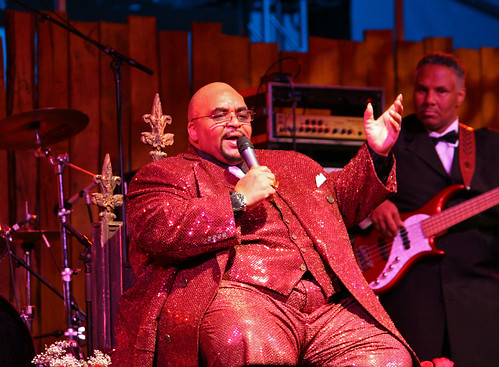
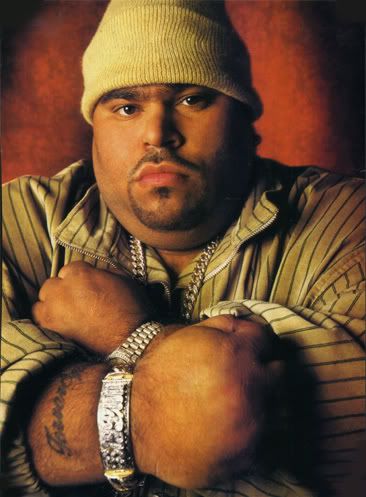
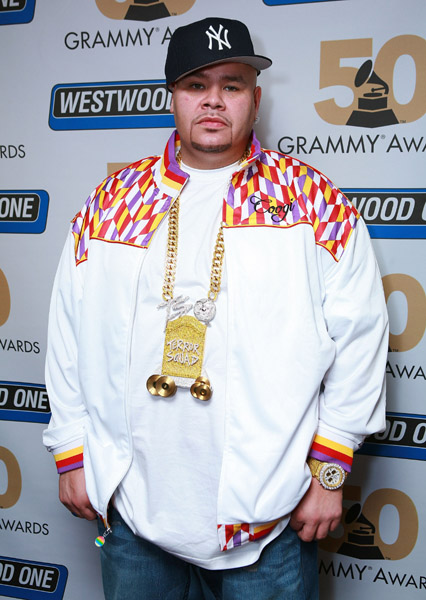
So who gets to be fat in music? Well, "outsider" women and feminine men, like the ones listed above. Performers in gay culture-based genres, like disco. And musicians from ethnic minorities - to take the obvious example of African-American music, there's Solomon Burke, Baby Huey, the often chubby Aretha Franklin, onto Missy Elliott, Big Pun, Fat Joe, Rick Ross. In short: musicians from forced marginalised groups, that counterpublic, are the ones who are allowed to be fat.


The question is why. There's obviously a measure of intersectionality going on here, several different systems of oppressions interacting. One can, for instance, see it from the perspective of the powerful: allowing overweight or disabled artists to come forward from marginalised groups emphasises their otherness. One could also talk about the correlation between minorities and poor people, who are often symbolised in today's society by their obesity.

But I think there is also a more positive spin. I think marginalised groups can be remarkably tolerant of other marginalised groups, caricatures of gay-hating immigrants or whatever notwithstanding. Disco, that ultimate music of marginalised group plurality, accepted gays, women, black performers, ethnic minorities etc. etc. in a way no rockist or hipster genre has ever done. Since each identity is outsider in itself, it makes accepting other ones easier. In fact, the artists generally allowed to come forward by the mainstream white society are the very pretty ones - look at motown's old stable - whereas the fat and ugly performers tend to stay in their minorities.

One more possiblity: Simon Frith has suggested that those who end up being the most creative musicians are the outsiders, the ones that don't really fit in. Maybe having a complex system of marginalities simply increases that possibility?