Showing posts with label race. Show all posts

2010-04-29

Okay, a comment then: Ethnic re-thonging

There was plenty of things wrong in spirit with yesterday's commentless blurb text, but the one that really has stuck with me today is one that for the most part is a factual error.

The text calls the use of percussion from a number of genres "tribalist", including, absurdly, kwaito. Kwaito, whose percussion is derived straight from Chicago house with some hip-hop additions. (Here's a kwaito man practising his "tribalist" drumming.) I would just laugh at it, normally, as a clueless ignoramus using bigoted language to sell mediocre music, but there's a process at play here that scares me.

Because, it seems, even in 2010 we can't imagine South African music as something not "tribalist". And it seems we do our darnedest to make sure it stays that way.

Last year Jace, aka DJ Rupture, wrote a great article channelling a lot of peoples' discomfort about the ethnification of third-world musicians. Along with many others, Jace has used his music and writing to do precisely what he suggests in the article - put a thong on the westerner, showing how all music is equally mixed, equally "ethnic", part of the same global rhizomic conversation. On the other end, it's been demonstrated again and again that supposedly "western" traits like electronics and modernity are extremely adaptable and easy to integrate by those so-called "tribal" people, who seem to have no problem at all ignoring "their" tradition once technology is available to them.

And yet, the same dichotomy seems to persist.

The Eurocentric elite world: neutral, modern, cosmopolitan, free

Everyone else: ethnified, ancient, bound by tradition

You'd think with stuff like kuduro and kwaito finally penetrating to our latitudes we'd have lost this divide by now. But its power is strong, and it seems like we're not done putting the thongs on the natives, not by a long shot. My very first textbook about reggae kept harping on about oil drums and bamboo poles, however irrelevant they were to the contemporary music; the writer from 14 tracks above has to make sure that it's the non-"western" genres that are declared tribalist. Factual truth - like the fact that South African DJs have been doing house fusions much longer than any of the musicians on his compilation - doesn't really matter, as the important thing is to make sure the dichotomy stays intact.

Then yesterday I came across this. A dude in Berlin taking club music and making it "ethnic", that traditional worldbeat exercise circa 1990. One portion mainstream, "western" club music, one portion of someone else's tradition, and bang, you've got the neutral-ethnic dichotomy enforced in a single track.

What's fascinating, though, is that every one of the supposedly neutral genres evolved, the ones that are eventually "ethnified", originally come from marginal communities in some way. Dubstep and grime are from the Black Atlantic diaspora and the urban poor in England. Jamaican dancehall - which only recently seems to have turned cosmopolitan and neutral, witness the amount of western-produced tracks called something-riddim recently - is of course from Kingston's poorer neighbourhoods to a large extent. This is another tactic in the maintenance of the dichotomy: appropriation, not in the accepting-and-receiving-influence sense, but taking a cultural expression from somewhere and wholly taking over the interpretative space around it. In this case, carefully whitewashing any trace of supposed "ethnicity" from dubstep, grime, dancehall, and making them fit neatly into the "western" slot of the worldbeat dichotomy.

And yet, we're all ethnic. And we're all modern and rootless. Jace and others have done a lot to make this apparent, but it seems that there's still plenty of people around who want to slip music into one category or the other, for possible later fusion. Either music has to be "tribal" or it must be appropriated and neutralised by the west. And that makes for a very boring world indeed.

2009-05-02

Blackface, part 1: Jamaica

In general Jamaicans are friendly, outgoing and very proud of their nation. [...] Jamaicans keep a positive and care-free attitude toward life, answering many questions or inquiries with a "No Problem Mon" or an "Irie" - believing that it's all going to work out and everything is OK!

-- from an online travel brochure about Jamaica

Most minstrels projected a greatly romanticized and exaggerated image of black life with cheerful, simple slaves always ready to sing and dance and to please their masters.

-- Wikipedia article on minstrelsy

The picture I posted on Wednesday depicts two men dressed as stereotypical Jamaicans. They're selling a commodity (pineapple) whose association with Jamaica is a largely colonial one - it's where the fruit is grown for global north consumption. They're largely dehumanised, wearing a generalised-exotic lava-lava in lieu of anything specifically Jamaican. The music is pastoral and rich-world-oriented "roots" reggae, in a fake plastic version... And their proscribed behaviour is carefree and laid back, much like the fake Maori in the last set of Fanta commercials (here, appropriately, in Estonian), and indeed much like both the stereotypes above.

And yet, it seems to still be okay. And I'm kind of wondering why, and discovering the wider implication of various angles on the blackface phenomenon are disturbingly plentiful.


I've nicked the illustration above from an online costume site, where it's advertised as "Rasta Mon Costume. This costume represents the carefree life-style of the Carribean Islands Mon!". I've looked through the site, and although there are plenty of costumes with some sort of parody intent directed at the hip-hop lifestyle, there are none that directly portray African Americans as an ethnic group in this way. Because that, of course, would be blackface.

I realise the historical and activistically racist context to this discrepancy. But surely, at the base of it, the problem is exactly the same. The blackface performer perpetuates an extremely simplified stereotype with strong negative or servile implications. He pretends to be an oppressed person in order to mock. The oppressed people are denied the custody of their own culture and the voice, they are spoken for by a grossly simplified parody of themselves, often for bigoted purposes.

And yet, dressing as a "Jamaican" in this way seems perfectly okay with most people. I've got enough issues, lord knows, with trustafarianism and middle-class white rappers as well, but at least they're trying to be something, not ironically mocking subalterns from a position of privilege. I cringe when I see stuff like this:


(via) What are Diplo and Switch thinking? Seriously? Having Andy Milonakis come in and do a perfectly ridiculous number in a faux-Demarco manner, cynically ridiculing the current style of dancehall and some sort of mystical, generalised-exotic voodoo bullshit? Exaggerating all the negative aspects, the violence and the drugs? Blabbing on about "pussy" in a manner which in the class/racial context comes accross as sexist in the extreme?

I can understand a desire (however warped it is) to want to be Jamaican or to want to act authentically so. But that isn't the case here at all. For me, when it comes to putting down Jamaicans by imitating them stereotypically - whether in costume or in music - there's really only one word for it.

In the next post I'll look at the idea of blackface as extended beyond ethnicity altogether - what happens when people imitate genders and classes, and how does that fit in?

2009-04-29

The Coca-Cola Company's Astoundingly Racist Store Display

Fuck me. I went shopping down at the Konsum in the mall, when I came across a promotional event for a new flavour of Fanta, Fanta World Pineapple: Inspired By Jamaica. I've worked as a store demonstrator myself and I know how ridiculous some of these stunts can be, but this is just beyond words. I'll let you spot all the offensive crap yourselves.


The music playing, of course, was generic astroturf-roots reggae.

2009-04-21

Is Hating Rap Racist?

Okay, so obviously saying that you hate all music made by black people is racist. Using a stereotype like "all black people are simple and carefree, and I prefer dark and complex music" is racist. Fine. Hating black culture in general is likewise racist by current definitions, although it does not include any of the traits traditionally associated with "races". But what about hating a genre of music, or a cluster of style traits in music, that are strongly associated with a particular ethnic group? In short: are people who vehemently hate hip-hop and rap actually racists?

Ignoring the obvious issues about the social construction of taste, I think I'd side with most people here and say no. But where's the limit, how far can you go? Can you relentlessly mock the imagery associated with the music? To take an example from another part of the world: can you honestly claim to hate manele fans (as many Romanians do) and then claim that you do not hate gypsies? And what would make that different from hating a distinct non-ethnic cultural group like "all muslims"?

I ask because of the general response in the Eurovision community to this:

Gipsy.cz - Aven Romale (Eurovision 2009 Czech entry)


I think it's probably less enjoyable than the stuff I've written about before from gipsy, having as a youtube commenter deftly noted quite a bit of Queen in it, which is not really my cup of tea. But it's quite funny, the video is gorgeous, and I like the Roma pride message. Literally everyone else in the Eurovision world seems to hate it though. In the Swedish national television preview shows, it got zeros from all five panel members and it was completely laughed out as ridiculous. Likewise, respected website Schlagerprofilerna gave it all zeros. So did Scandinavia's biggest newspaper. It's right at the bottom of the ESC Today charts.

Would it even be possible to heap this much hate on a song that was black pride or gay pride? Can someone who's better versed in the intricacies of structural racism inform me?

2008-12-06

Offending muslims is pretty much like offending everyone else

I've been talking to a Muslim friend of mine about the two recent controversies involving Quranic verses being used as lyrics for popular music: first the removal of a track from video game Little Big Planet, then Busta Rhymes' supposed quotation in a recent remix. I asked her about whether the use of Quranic material in music is forbidden in Islam or not, and she told me, totally obviously in hidsight, that it's entirely dependent on the context.

Because, honestly, offending Muslims is not radically different from offending anyone else. Muslims are not only diverse but for the most part thinking human beings who understand things like intention and effect, and can understand perfectly well where a supposed offence comes from and what it means.

There's in fact plenty of Quran-quoting pop music even in the heart of the middle east. Literally Islamic pop music exist just as much as literally Christian pop, without any problematic connotations whatsoever except to some extremist cliques. British-Azeri artist Sami Yusuf sells millions and millions of albums of western-sounding pop with a deeply Islamic message. Even borderline use of the Islamic message to further political goals is largely accepted without much grumble: for instance, there's plenty of Hamas Anasheed which in social position is probably vaguely the equivalent of gang rap and has a kind of Hollywood-cinematic-synth sound, yet has very obvious Islamic lyrics.

Why is this accepted? Because these people are Muslims. They're doing it out of faith. They're not wantonly associating the message with drinking and sex and racist stereotypes, like Busta. Or (as it were, not) using it as a soundtrack to mindless gaming, like Sony. It's honestly not that strange, and I'm sure people of all faiths have similar relationships with their holy books.

So why is there this tendency in the media to portray Muslims taking offence at something as somehow exotic and irrational? It always has to be portrayed as a "religious ban" on a certain expression, and the exotic-sounding words "haraam" and "halal" end up in a lot of the coverage. There seems to be an undertone that there's no rational reason for the anger, that it's arbitrary just like not eating pork is arbitrary. That way, it can be straightforwardly dismissed as something "they" do.

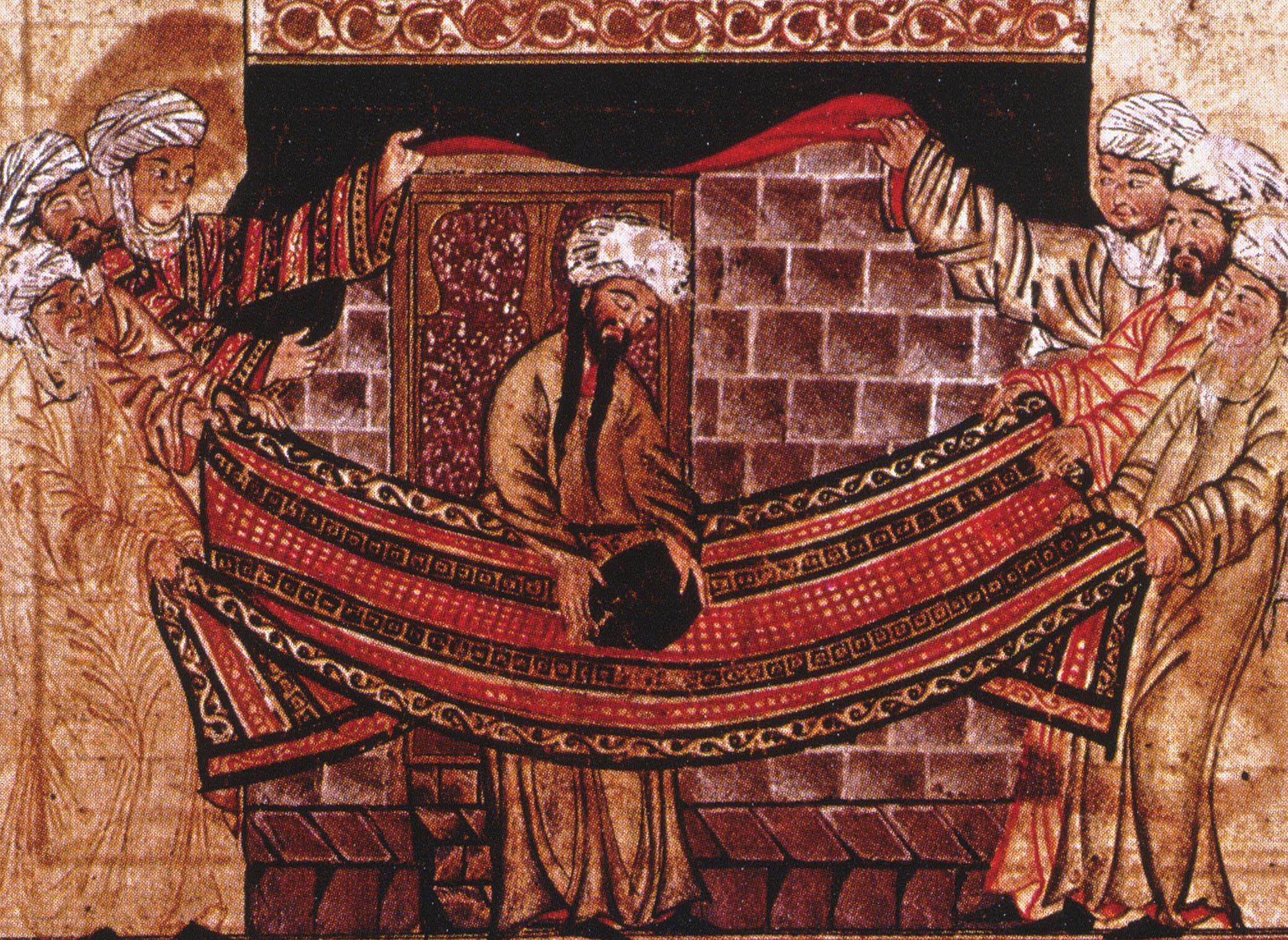
Perhaps the clearest example of this is the now infamous Danish Muhammed cartoons. Almost uniformly, the outrage that many Muslims felt over these cartoons was attributed to the Islamic ban on pictorial representations of the prophet, despite the fact that such a ban is far from universal and that Islamic art history has a long tradition of Muhammed paintings. Devout muslims have, and still are, depicting Muhammed with religious chastisement and discussion as the only potential result, but Jyllands-Posten's publication was something else entirely: an acknowledgedly racist newspaper, printing cartoons with the explicit intention of denigrating Islam, with the effect of futher marginalising the oppressed Muslim minority in Denmark. Of course Muslims were angry! I was angry too. So why the need to relate it to the exotic and supposedly arbitrary?

And of course this latest controversy is not as "bad". Neither Busta or Sony have had the intetion of insluting Muslims, however insensitive they might be, and therefore it's not raised much of a furore. In fact, my Muslim friend tells me the Sony delay has been highly praised on Islamic message boards, which opens up the possibility of it being merely a deft marketing move. And Busta's sort of passive, unintentional stereotyping is not nearly as worthy of anger as the very prevalent active racism against "Muslims" that we see everywhere, and the vast majority of Muslims recognise it as such. Seeing as they are in fact thinking human beings, just like the rest of us.

2008-11-03

Social Class I: Watermelon

I was at a party at the home of a fellow blogger recently when I fell into a conversation with another blogger, prompted by my assertion that I don't much like East Coast hip-hop, especially not the rather middle-classy Native Tongues type material. At which point he retorted, in paraphrase:

"So you like your hip-hoppers poor and out in the country, eating watermelon? You don't want any uppity black people, right?"

He was joking, of course, but it hit home more than he realised at the time. Because it's basically true: I prefer small-community, dance-oriented, working class hip-hop to cosmopolitan, underground, middle class hip hop. Does that mean I'm buying into the Jim Crow stereotype of the carefree Negro in a straw hat?


What I'm basically facing here is an issue of intersectionality. The ethnic minority of black people in the US and in Europe are, as a group, marginalised, and the majority of them are relatively poor. The struggle to escape poverty, for them, is twofold: not only is it economically problematic, but the stereotype society has of them is that they're poor/untrustworthy/criminal, making it all the harder to get anywhere else. In fact, in the US at least the idea of "black" and "working class" seem so closely intertwined that we get phenomena like this.

So it's difficult to honestly claim a growing black middle class is a bad thing - it's definitely a crucial step in the breaking down of the negative stereotype and in integration. But the question really is what do we mean by integration? There seem to be hundreds of models, both of what is desirable and what we actually mean, and often integration is defined purely in terms of economic success. I don't think it's nearly that simple. One favourite model of mine, from when I studied journalism and which I despite incessant googling have not been able to find the source of, has three levels:
  1. Segregation, in which the marginalised group is excluded from the public sphere entirely and does not have access to the higher positions in society. The culture of the dominant group is completely prevalent, while the culture of the marginalised minority is actively repressed.
  2. Partial assimilation, in which the vast majority of the marginalised group is still excluded and its culture relatively repressed, but in which a small elite within the group is allowed to rise, but only if they actively adopt the culture of the dominant group.
  3. Integration, in which both groups have adapted to each other, and both cultures are considered equally good and are both part of the public sphere.
I really like the emphasis on cultural rather than just economic equality in a model like this. In particular, I think the idea of the second level is very apt for a lot of groups in society - here in Sweden, for instance, there's plenty of Kurds in very high positions with largely mainstream values, maybe even disproportionally many, but that doesn't mean the majority isn't oppressed and that Kurdish culture isn't oppressed. Likewise, when it comes to black people there are successful ones (like these two that are in the news a lot today, Monday), but they're a relatively small minority and, crucially, they've been forced to adapt to the mainstream culture to gain success. Like women who have to be more "masculine" than the boys to succeed in management, successful black people often have to be extremely mainstream in every way in order to not appear as an "angry black man" or some other stereotype.

This partial assimilation may be needed for there to be equal access for a greater variety of black culture in the future, but (and here comes the point of the post) it doesn't make for very good music. Completely assimilated artists are one thing (yes, liberals, there are black people in all sorts of music) - no shadow falls on Bad Brains or TV on the Radio; they're basically part of a mainstream white culture. But a lot of the sort of partially assimilated half-measures, the "black" music created to garner acceptance with a mainly white audience, often comes across as superficial, trying too hard, a bit hesitant, not daring to go towards any interesting extreme. And that, to give a fuller answer, is why I'm not so fond of De La Soul. (And global fusion music.)


So what of the minstrelsy Negro in the straw boater and the toothy white grin? Well, as a destructive intersectional stereotype it goes two ways. Yes, it's a conflation of the categories of "working class" and "black". But in its details, it's also a demonisation of actual black working class culture. Mainstream middle-class white society (which, of course, is the public sphere really) has a great tolerance for middle-class black culture of the kind above - all my middle-class hip-hopper friends here in Sweden are fond of "true school" hip-hop and underground hip-hop. Meanwhile, there's a great intolerance of working-class black music - again, the Swedish hip-hoppers usually deride it as "LCD Rap". The watermelon man is a thinly veiled depiction of the hate felt towards actual working-class, rural blacks.

I think there's a great value in working class black culture, and I try to do my best to promote it. I'm not going to go around saying it's the "real" black culture, that sort of essentialist statement only leads to dismissal of legitimate expression, but I do think that in order for there to be full, positive integration its value needs to be recognised and it needs to be stopped looking down on. We need to stop assigning stereotypes of all sorts and appreciate whatever someone wants to do, and whatever they chose to communicate. And I don't know about you, but I'm always happier when ABN comes up with something introspective than when Atmosphere does.

This is the first in a series on class. Next time I'm going to deal with segregation, elitist Obama supporters and how class issues are affected by a recession.

2008-09-04

American white suprematist hip-hop disguised as underground radicalism

You know, it's weird. I never thought American nazis or pseudo-nazis would actually use hip-hop to convey their message, at least not yet. I must be painfully naive or something, but I thought hip-hop was, you know, the enemy.

But lo and behold:

Q-Strange - Pop


Good lord. The entire track is dedicated to graphically depicted lynching fantasies of a series of black musicians: Terror Squad, Akon, T-Pain, Soulja Boy, Young Dro, DJ Unk, Mims, Black Eyed Peas, Beyoncé, Rhianna, Ciara, Dannity Kane.

Don't ever come running again saying underground rap isn't essentially racist.

2008-08-20

Is great art automatically less racist?

Just a quick reflection.

Read in the newspaper the other day about the CinemAfrica festival here in Stockholm, where a spokesperson claimed they only showed films by African film-makers to get a "proper inside perspective". Then I watched a film that was clearly done from an outsider's perspective: Colors, Dennis Hopper's film about gang violence in Los Angeles. It wasn't very good. The characters were a bit simplistic (helped a bit by Sean Penn and Robert Duvall in leading roles as two partner cops), the plot thin and disjointed, and the portrayal of street gangs as far as I can tell inaccurate and simplified. I quit watching 2/3 through the film.

Jeff Chang claims most gang films, like The Warriors, Assault on Precinct 13 and Fort Apache, The Bronx, are fundamentally racist. I'm fairly sure he'd attack Colors as well - it's got a similar set up of one-dimensional gangsters, most black and Latino, attacking the protagonists, who are somewhat more fleshed out.

But I was thinking, what about The Wire? Everyone likes The Wire, which is (at least in part) a "gang tv series", and no-one claims it's racist. Sure, you say, in that all the gang members are complex, living and totally not dehumanised. And that's probably the difference. But isn't that quite simply a sign of good art? Could it be that high-quality art is, by virtue of its aesthetic qualities, somehow less racist?


I'm not really up on my classical aesthetics, but there's plenty of angles on The Wire that you can claim makes it a great piece of art. It's complex. It's subtle and refined. It brings out universal themes. It's got a deep humanist heart. Etc. etc. By contrast Colors is not very good art at all. Since by its form it's totally simplistic and one-dimensional, it's no surprise that the black characters are depicted as one-dimensional and defined by their ethnicity, making the film racist. Bad art is way easier to make racist than good art.

I'm sure there's plenty of examples of this kind of think in music, too, stuff that's actually just bad and insensitive and that becomes racist through just not being good art. But the only one I can think of straight off the bat is "Fattig Man Söker Efter Mat" by wonderful kooky eccentric Hans Edler, whose depiction of third-world life is fucking ridiculous, fucking simplistic, bad art, and quite a bit racist no matter how well-intentioned. Unfortunately I've not been able to track down a copy to post a link, but it's in Swedish anyway.

Anyone got any other ones? Or tracks rescued by being very good art indeed?

2008-08-11

Isaac Hayes, Stax and Black Power

The recent death of Isaac Hayes has been reported in loads of blogs, but it seems the political aspect of his life has been a bit overlooked. The thing is, even though his political angle was far from controversial, I think it's interesting and well worth considering, even today. I might even have agreed with it.

Because it goes to the heart of the issue of race and cultural collaborations.


Stax records is legendary in part because it was the ultimate race-integrated collaboration. Its producers were defiantly cross-cultural, controversial during the tail-end of the segregationist era. Its house band, Booker T and the MGs, was perfectly 50/50 split between black and white musicians, with a black band leader. Everyone was working together and the result was some completely stunning work that ranks among the best soul of the 60s – not least on Isaac Hayes's production collaborations with David Porter. Isn't it marvellous to see the black Al Bell and Booker T Jones in that clip, perfectly gelling with the white Steve Cropper and Donald "Duck" Dunne? Doesn't that hit right at the spirit of Stax?

Isaac Hayes was the one who destroyed it.

Well, obviously, he wasn't alone. And although his lawsuit of the label in 1974 might have been the thing that pushed it over the edge of bankrupcy, the seeds of discord were sowed much earlier than that. When Al Bell took over half the label in 1970 Stax ended up splitting into separate camps, then falling apart altogether, along cracks that had started appearing several years earlier.

Because at some point in the late sixties Isaac Hayes started realising that the perfect race mix wasn't enough. He started asking questions like: who benefits from my music-making? Who earns the profits? Who, ultimately, decides? (This was around the time he was being most strongly hampered creatively by the rigid (though brilliant) "Stax Sound", so that probably has something to do with it.) Well, who made the profits, and who ultimately decided, were white people. No matter how independent and how "r&b" the label was, it was run by Jim Stewart and his sister Estelle Axton. And with the widly successful tour of Europe in 1967, the market was also increasingly the white kids across the Atlantic.

Isaac Hayes started protesting. He wasn't going to be part of a pat, "race-blind" operation in the increasingly concious seventies. With new co-owner Al Bell (who was black) brought in and Jim Stewart and the white elements pushed out a few years later, Stax became a different company all together, one full of Black Power rhetoric. Maybe a change for the worse creatively, but I personally don't think Isaac Hayes was wrong in asking those questions.

Maybe there are some people who ought to still be asking them today.

2008-07-28

Almost

I've spent my weekend swimming with the hipsters.

I was at this lovely little festival at a traditional folkpark, which had loads of things going for it, not least the fact that it's tried to keep the local folk park alive and up to date. Slightly more troubling was the fact that the local presence was negligible - instead they'd bussed up oodles of hipsters from the big cities, mostly Stockholm, who did hip performance art, ate hip food and listened to hip bands. Quite fun nonetheless.

Two of the artists performing at the festival should strike a familiar note to some readers here: Leif and Rye Rye. Both make music that can be vaguely (though questionably accurately) described as a (re-)americanisation of British grime, filtered through bmore and through the hip dance clubs of New York. Rye Rye, at least, does it very well too. But what I find interesting about these two is that what they do is almost the music of mainstream African-Americans - yet it is the little difference that makes it acceptable to hipsters.

Because hipsters love almost the real thing.


The hipster category of almost has a huge history with wildly veering styles and qualities. It'd include people like Scott Joplin. Paul Whiteman. The early Rolling Stones. Janis Joplin. The entire genre of Jazz-Funk. Bob Marley and the Wailers as produced and marketed by Island Records. The eighties had bands like Was (Not Was) and Pigbag. Today? Well, Bonde De Role, just to take an example.

And before we start pulling up theories about race and minstrelsy here, this certainly doesn't just apply to black acts adopting traits of the hip, white upper-middle-class or vice versa. The festival I was at had a band that was almost rockabilly. (Rockabilly is a strong working-class marker here.) Screamadelica was almost house. And what is the entire genre of alt. country if not almost country?

What's going on here? Obviously hipsters prefer acts that are able to speak their language, act the right way and wear the right clothes to get to them. Was (Not Was) may play fairly conventional electric boogie on that record, but they present the image of a hip post-punk rock band which makes them appealing to hipsters. Leif maybe couldn't rap very well, but he certainly knew how to dress snappily! Quality markers vary greatly from group to group, so obviously hitting the right ones works.

Still, that invisible wall between the acceptable and the unhip can sometimes be very thin indeed. Look at poor MC Gringo, who has earnestly tried to fit in into the Rio baile funk scene - suddenly he's whisked away to hipster pop festivals all over Europe. Yet his music is not amazingly different from that of dozens of acts - it's merely his whiteness that, in hipster eyes, makes him almost baile funk. Meanwhile, his contemporaries without the hipster access are left in the favela, since they really are baile funk, no almost about it.

I can't help but wonder why this is the case. If the reason hipsters are brushing up to black/third world/working class music is because it's thrilling, why don't they go all the way and book proper hip-hop acts to their little festivals? And if they think that music is actually naff and the people who make it square, why do they keep flirting with it so much? Anyone got a theory for me?

I guess the reasons are not a million miles away from why the hipsters from Stockholm placed their little festival in a folkpark in a little rural village without ever actually meeting the villagers...

2008-05-30

Where are the Diasporadic DJs?

A couple of years ago Tanzanian megastar Mr. Nice, whose music I much admire, came to do a concert here in Stockholm. I missed it. Never even heard of it. The concert took place in the immigrant-heavy suburb of Norsborg, far out on one of the subway lines, and as this video shows the attendance was almost 100% diasporadic East African. Any white faces you might spot in the crowd are very probably friends or spouses.

At the parties of DJ Thomas Gylling, who plays Soca, Dancehall, Reggaeton and other caribbean music at large upscale clubs in central Stockholm, the reverse is largely true. Here's a video montage of some crowd photos - there are probably a couple of diasporadic Trinidadians and Jamaicans in the crowd, but I'd guess not many. The majority are middle-class Swedes, some of mixed race, most white.

Now, I'm not going to tiresomely go around and try to argue that this is all somehow wrong. It's inevitable, considering the different cultures and classes involved. But what I do wonder is - why isn't there more exchange of DJs between the two club forms?
I'm a frequent RSS feed subscriber to a whole bunch of sites of DJs in the "nu whirled music" scene, like Dutty Artz and (Rupture's) Mudd Up! and (Maga Bo's) Kolleidosonic and Wayne and Wax. As DJs, they all frequently advertise club nights they participate in. I've been searching through some of the names on the bills and found almost none that regularly play events for a diaspora in the same country. I think DJ Chief Boima (weclome to the blogging world, dude) might do, from some of his comments, but it's certainly not a frequent occurence in general.

And as for the opposite, DJs who regularly do diasporadic events doing mainstream club nights, that's unheard of too, no matter what kind of music is played. Sweden has loads of interesting clubs playing non-european music, like Re:orient Club. Looking over their DJ roster you do see non-swedish DJs but none of them are from the same set that would play your local Lebanese night. No, names like "DJ Shazam" and "DJ Cheb Oman" belong to white europeans, not arabic immigrants.

It seems that deeply entrenched diasporadic DJs just never get to play to more mixed crowds in different settings than the diasporadic one. And I'm kinda wondering why. How come you never see someone like DJ Oslus DJ a party of largely college-educated white kids? If you're after knowledge of African music surely someone like that would be a good choice. Are they not good enough? Don't they send out the right kind of hipster signals?

I think there's a deep inherent danger in only allowing middle-class DJs with existing access networks to present music from the developing world. The DJ is a story-teller and manipulator and can form the discourse concerning a musical style at will - are we only ever going to hear one side of the story at party nights? I do realise that bringing a new audience and revenue stream to people might alter what they play for the worse. But is it worth the risk of one-sidedness in transmission and translation?

If Mr. Nice ever does come back to Stockholm I'll try to go see him, whatever the venue and however uncomfortable I'd feel. I'm keeping tabs on the community now through the Kenya Stockholm Blog. But wouldn't it be awesome if some club promoter would have the courage to bring him and his DJs to Berns instead?

2008-04-27

Race and the Novelty Song

When the Spanish Eurovision winner was announced my immediate reaction was a very defensive one. Here was, I thought, a fairly straightforward humorous reggaeton track and it was being dismissed as a novelty song. Of course, once I'd done a bit of rudimentary research it turns out to actually have been a novelty song all along.

But the central problem still remains. As I prepare to write the mega-post on Eurovision novelty entries I promised, I have to face up to precisely the problematic connotations of the term "novelty".


The idea of the novelty song is a western construct, coming out of Tin Pan Alley in the twenties and thirties as one of three major categories of vapid pop. Over time it's come to acquire somewhat negative associations - it's a song that's exploitative of a fad or news item, without much musical substance.

I remember how livid I was when Mundian To Bach Ke was repeatedly reported as a novelty song, since it's actually well-rooted in a bhangra remix tradition going back a decade. But in the context it was being used - mainstream European house clubs - it functioned precisely as a novelty, something fun and throwaway for the moment. Innovation, or the potential integration of new cultural elements, was reduced to the mere temporary entertainment. That sort of thing has been exceedingly common over the years - look at the dance world, where wonderful, fully-formed dance genres like rumba and merengue were reduced to novelty dance crazes, never taken seriously.

I would argue that this happens all too frequently to genres from the third world, and that to some extent the novelty tag is a (rockist?) western master supression technique against other cultures. Look at the features usually associated with novelty music: flamboyant performers, extra-musical effects, innovative and unusual instrumentation and techniques, use of humour, connection to current events or fads. Is it a coincidence that these are way more common in a lot of third world music (and African-American music) than in mainstream rock-pop? (Exception: Metal.)

In any case, treating music as novelty is dangerous because it can often suppress innovation (Dickie Goodman famously presaged sampling), and be used to foster conformity and complacence. Every time I see this clip of Tiny Tim I feel angry at the bullies who feed this self-confident outsider musician into the mill of novelty, denying him the right to be funny on his own terms.

So while I'll sometimes use the word novelty for a deliberately constructed pop song, I'm going to be much more wary of bandying it about in the future. And I'll definitely look at every novelty song deeply and try to understand it on its own musical terms, including its background.

2008-03-19

Does Your Assigned Stereotype Really Permit That Influence?

I'm fairly adamant generally that world music is bad, but if there's one thing I can usually accept that gets lumped into that category it's the pre-existing music. Something someone has heard (rather than made) and decided to pass on to the west. Heck, I'm guilty of enough of that myself to defend it, at least when it's knowledgeably and respectfully done and the selection is fair and based on the received wisdom of the scene itself.

But even as I'm involved in this sort of thing myself, I've recently started to realise the magnitude of its problems. The biggest one by far, I think, is our discourse of genre selection, and I find myself asking: what types of music are we really selecting, and what is our real reason for selecting them?

And I'm afraid, I'm very afraid, that the reason is stereotyping.


I generally consider myself some sort of hip-hop/disco fan and most of the music I've chosen to pass along has been young, electronic, "hard", bass-driven and working class. That type of music certainly gets some attention, and over the years seemingly disparate material like (to take three examples) Cambodian garage rock, crazy eclectic Bollywood music and South African semi-modernised dance music has ended up in some hazy media spotlight. Why this material exactly?

Chance, I guess. Quality to a certain extent. Accordance with the usual prejudices of "world music" in many cases, like that they're a bit exotic, fairly unthreatening, fairly old. (80s Bollywood, clearly superior to the 60s material previously touted, has only recently been accepted in world music circles.) But I think that even if we chose to factor out all these things there is a clear prejudice to the genre selection that I see in myself and that I'm very uncomfortable with.

I think a lot of the music is picked because we have expectations that certain people are going to conform to certain stereotypes. The Indian film music composers are allowed to be genre-crossing music thieves, but you'd never see crazy eclectic Latin music. Or South African garage rock - Africans are meant to copy African-American music, right, and make blues and funk and hip hop-based modernisations? Everything else is sorted away.

We all love it when someone in South East Asia creates a dynamic hybrid genre with hip-hop or something. But what if they decide to use heavy metal instead, like in morlam sing?


You could argue that metal is a "bad" genre and hip-hop is a "good" genre, but I think there's also an underlying assumption that metal is a "white" genre that "ethnic" people can't take their lead from, so this kind of hybrid is never properly explored. I certainly would have ignored it a few years ago.

Plus there's a whole bunch of conventionally "good" genres that people in the developing world aren't allowed to take their lead from. There's a really good shoegazer scene in Singapore, for instance, that we will never hear about because it's not "their music" - people "down there" are meant to make funky working-class music with ethnic undertones.


When I consider this sort of built-in prejudices I'm truly thankful for a blog like the wonderful with comb & razor, easily my favourite MP3 blog at the moment. From his vantage point on the scene in Nigeria, the author scours for quality local vinyl of every type and genre. Recent highlights have included Nashville-style country (which, of course, was also wildly popular on Jamaica), a coloratura soprano singing faux folk songs and the overture of a Nigerian opera. None of it is bad either (okay, the opera kind of is), but you'd never hear of any of it in the sea of Afro-funk and ethnic sounds that is our stereotype of Nigerian music.

2008-01-24

The problematic issue of the white audience

"The litmus test for the authenticity of a particular artistic expression can never be the people who consume it. It has to be the issue of what you intend." - Professor Michael Eric Dyson on Black Tree TV.

Hello. My name is Johan, and I am a white male.

Twice this week I've been reminded of this fact (as if it would normally escape me). First, Anton Hultberg Hansen wrote something really interesting in a commentary thread at Swedish hip hop blog Kinky Afro (in Swedish, unfortunately). Then I tried my utmost not to get drawn into a flame war by an unpleasant troll at Counterglow, and my moderately sloppy attempt at reasoned debate again brough out the race card. So whether I've wanted to or not, I've had to think about the issue of what white-maleness means in terms of the consumption of culture, and more disturbingly what my white-maleness means when I consume culture.

In the video quoted above (that Anton clued me on to) Professor Dyson says something else interesting. "Blues music today is primarily consumed by white people. Does that mean B. B. King has sold his soul [...] to white suburbia?" It's meant to be a rhetorical question, of course, but that doesn't mean it can't be answered in an interesting way. As a starting point for exploring this thorny issue, here's pretty much what my reply would be.


We white men excert a disproportionate amount of power in this world. We largely control the capital and a significant proportion of the buying power. We excert most of the political control. And because of our generally better access to education and outlets, a large part of the discourse about our world is performed and set in stone by us.

Generally I think we can all agree that there's a persuasive argument to be made for looking beyond this discourse. History (as dictated by us) and taste (ditto) has cast away a lot of interesting cultural expressions through the years, mostly those by women and ethnic minorities, and it's definitely worthwhile to try to reexamine that which conventional tastemakers have skipped over. I don't think anyone (short of a bunch of conservatives) can object to the idea of broadening the listening repertoire and reinstating the forgotten.

A more controversial approach would be to try to examine the roots of the pervailing discourse and explore its motivations and underlying presuppositions. In the case of B. B. King, one could ask what exactly it is about him that makes him appealing to whites to such an extent, and if your answer is age, unthreatening exoticism, the prevalent desire for the primitive and his direct marketing aimed at whites then you're inevitably in for a fight. (If you answer quality, life-wisdom and closeness to tradition you're probably safe.) Connecting the arts to a wider society, especially if you question the basic premises of the ruling elites, is never going to be easy.

Still harder assualted would be the proposition that, yes, B.B. King is a sell-out. He's chosen to make a music that's directed and sold towards a white male audience, one might contend. Isn't that practically the definition of a sell-out? Someone who chiefly markets to those outside their own core group? I've known myself to make this argument on occasion, and argue from quality that music that's marketed mainly towards it's own group has been "good" and that if it goes on to sell to the powerful it is "bad". It's not difficult to pick out examples like Washington go-go, which in a matter of years went from excellent to tired solely on the basis of the switched audience. I also have often made a colonialism-type claim, saying that the labour of the musicians mainly benefits the already powerful.

This sort of scheme is fairly easy to apply to contemporary music (or historical music that was at the time designed to appeal to The Man) but what about historical music in general? In his early days B B King never envisonaged his later appeal to a broader audience. Does the fact that it appeared taint that stuff too? What about something like northern soul?


That's another genre of black music where white men provide the expertise and audience. However, it is on records and the records were, at the time, created mainly for a black audience. So does that make it alright? And is it even true? Motown's chief revenue was, after, all, white people. Is that a reason to devalue Motown? It was explicit in selling to white people, so it never sold out, right?

Which brings us around to the main issue in the video, Hip-hop. Newpaper columnist Stanley Crouch makes a claim that 80% of hip-hop is consumed by "white guys in the suburbs". I've no idea if this is true but it might well be the case. The difference, if one was to base a critique of B.B. King and his audience on this sort of figures, is that here it is not the intended consumers that matter but the actual consumers - the very fact that white people are buying it is problematic, independent of who the music was created for. (Hip-hop is generally marketed towards a black audience, with the exception of the most commercially viable set and backpacker rap, making it not sell-out if you only care about intended audiences.)

Even I balk at this fourth possible approach (which Anton advocates in his biggest post in the thread) but some of the things it implies hit unfortunately close to home. For instance, if like me you're mainly interested in music created for those who are very different from me then aren't I also promoting the exotic and participating in a neo-colonial game? There's a huge gap between me and the poor kids in the favelas of Rio de Janeiro. Am I a "global hipster", naively glorifying poverty? Then there's the issue of expertise - if we white males learn too much about this music could it be that we're the ones who write its history and discourse? Are we just as bad as any previous generation of white male as per above?

These things worry me, and yet I don't feel like taking the defensive approach and only listen to music from my local cultural context. I think the solution is self-distance, humility and constantly questioning your own premises, therefore this post among others.

So, is B. B. King a sellout? Probably not. Maybe in some contexts.

Is his music irrelevant because it's being bough by whites? No. But certainly it's no more relevant than all the music white males have passed over.

Can I, as a white male, legitimately promote this "passed-over" music without integrating it in the discourse of "music accepted by white males" which I'm trying to defeat? Probably not that either. But at least I can try.