2009-10-13

Genre of the Week: Logobi

Wow. Something is really brewing, again, on the streets of Paris.


Sometimes you find about new music from strange sources. The video above was posted today, not by one of my usual sources, but by Momus. Consequently I know nothing more about the genre than I can find by googling, which isn't much.

The dance above is called logobi or logobie or logoobie, and it's pretty much entirely new, with no references existing prior to 2007 and exploding in content and popularity this year. It seems to have derived to a certain extent from coupé-decalé, though it's considerably stiffer, jumpier and has almost tektonik-style arm movements. The practitioners seem fairly uniformly to be very young, black french kids, though rarely as young as this:


Socially, these kids all seem to have god-awful, mid-nineties-looking blogs on social networking site skyrock. It's a good place to search for tracks of the associated music, which annoyingly often is anonymous and untitled, appearing under the heading "logobi instru", just "instru" or sometimes "coupé decalé instru". The latter ought to give some indication into the origin of the genre, as homegrown instrumental versions of coupé decalé, and indeed the very earliest material seems to be just that. Dancers then chant stuff over them.

However, more recent instru has evolved in a completely different direction - it's been totally infused by european dance music, and to a certain extent kuduro and hip-hop, while retaining a basic coupé decalé beat. The influence is not, as expected these days, primarily from commercial trance and electro house; instead the genre contains copious amounts of dubstep (like here) and hard trancey techno, like jumpstyle (e.g. here). Some of the best material fucks around with the beat as well, like this track.

It's fairly exciting music all round - there's a huge variety of percussive sounds (including timpani, orchestral hits, cymbals and snaps), it's varied, rich and polyrhythmic in interesting ways. None of it has settled to form yet, and all the artists creating seem to be around 14, which is definitely a plus.

Now please, all those of you with a finger in the francophone-African air, can you compliment this picture with some history and connections?

2009-10-12

Where's all this relentless experiencing coming from?

What's the deeeal with experience? In southern Sweden, one of the regional newspapers has done a brilliantly-conceived survey of all the members of parliament, asking them about their cultural preferences. I love that sort of thing - there's plenty of material to be analysed and indeed articles have done so already. I'm probably going to give it a go at some point myself.

Meanwhile, though, I have a huge gripe about the survey, or rather one of the questions asked. The parliamentarians are asked to provide their favourite movie and book, but when it comes to stage performance, art and (for the purposes of this blog most obviously) music, the question is modified to "what is your greatest experience of...?" But, I mean, who cares? The question tells nothing about the people involved but only of their past selves. Personally, my greatest musical experience is undoubtedly Neil Young at Roskilde in 2001. But I've heard and taken part of much better music since then, just not experienced it so unequivocally and intensely, and my tastes have changed almost entirely.

I don't much like the sort of vulgar phenomenalism that these questions entail either. Music as something to be "experienced" in and of itself smacks of 19th-century darkened concert halls and direct communication, while I've been enjoying music mainly in a functional setting for the past few years of my life, on the dancefloor on both sides of the deck or in a radio studio. Or just listening to it at home or watching videos or whatever. It's always been mixed up with other stuff (great dancing experiences, for instance), and it's not really active, reflective experiencing as such.

What do you think? Do you primarily like music because you experience it? What relationship does your favourite music have to your greatest musical experiences?

2009-10-05

Glitchhall

Jamaican music has long been a contributor to the European avant garde and you'd be hard pressed to find a contemporary highbrow genre in the nebulous art-popular field that doesn't reference or relate to (at least) dub in some way. Glitch, for instance, definitely counts dub among its chief influences, as Jamaicans were among the first to create music on a larger scale by consistently misusing technical equipment to create strange noises.

Well, in autumn 2009 this influence seems to have gone full circle. Listen to these two recent tracks by major Jamaican dancehall artists:

Black Ryno - Pon di Earth (produced by Demented)


Busy Signal - Black Belt (produced by Kirkledove and Jukeboxx)


The riddim (Arrhythmia) of the first track has a second "snare drum" totally done in glitch style with some sort of noisy digital cut thing, whereas the "metronome" in the second track seems to be made up of skip-around clicks. Brilliant! I'm not going to claim it's a conscious connection, but some people in Jamaica are obviously fucking around with their machinery... AGAIN.

2009-10-04

While on the UK Funky note...

I'm totally chuffed at the way mzansi house number Turn Me On by Black Coffee has become a huge hit in garage circles in Britain. Not only is the exchange aspect marvellous, but the tune is great as well, a really sophisticated, slightly trippy number with deep house jazz chords and nicely soft-padding percussion. This is emphatically not the type of music lifted by "global ghettotech", and it's great that it can transverse the continents without a Galliano-style explorer attached.

2009-10-02

African Music's Fictional "Africa"?

Quick question. A lot of people, including me, seem to think Argentinian producer Douster's track "King of Africa", for all it's hipster irony, perpetuates some incredibly old and tired stereotypes of what "Africa" stands for. The video hardly seems to make matters better...


Besides the animals and the crazy-dancin' tribesmen (full respect to the dancers, I'm thinking from the video-makers perspective), there's the whole reduction of Africa, one of the world's most diverse continents, into a single unified exotic whole.

I don't seem to recall a similar outcry, though, when funky used a similarly hackneyed idea of what "Africa" means during its African tribal craze last year. I mean, Donaeo, an "African warrior" with his stick in his hand?


Is it, pardon me for asking, different when black people have a shallow, unitary, hackneyed idea of what "Africa" is? Is "Africa" as Hollywood extravaganza really that different from, say, "Africa" as supreme, wise spiritual homeland? Obviously there's a line somewhere, I draw it too, but what, ultimately, should we think of actual, you know, Africans who have a hackneyed, unified idea of what Africa is?


Or whatever. Are we to take this as a more "genuine" idea of what Africa means, and therefore deny third world musicians the ability and agency to be stuck in precisely the same shitty paradigmatic discourses we have (or construct equally stereotype-laden ones of their own)?

2009-09-28

The Middle Section of a Hardstyle Song

I'm usually a person who happily dismisses music on listening to the first thirty seconds of a song. This means, however, that I've been having huge problems with hardstyle.

I've been downloading a bit of the genre recently in a random, newest-torrent search on some vaguely illegal sites - I'd make that a proper esoteric research method if I thought I could get away with it. And what's surprised me is how intricate and interesting the melodies are, how well-crafted the harmonic progressions, how dynamic and hook-filled the songwriting. It's, quite simply, good pop.

But, interestingly, not all of it. Only a bit in the middle.

Here's a fairly extreme example:


Activator - Activator [Youtube link with download option]

There's absolutely nothing resembling melody at all, only rumbling kickdrum surrounded by percussion and spoken commands, until about 3:19 in.

Then suddenly there's this flowering of hooks, synth instruments vying for attention, dramatic buildups, symphonic stabs, trance-bleeps meeting the highest level of R&B euphoria, a huge hi-nrg winddown, all changing, swirling, supported by well-crafted percussion programming. Then at 6:00 it all stops and returns, absurdly, to just the beat. Wow.

This shit obviously cries out for a re-edit of some sort.

2009-09-25

Tiki the Subculture - and Tikitech

Everyone reasonably immersed in American popular culture knows about tiki. Primarily a theme for bars and restaurants with a supposedly Polynesian flavour, it was born in the thirties, blossomed immensely in the fifties and died, more or less, with the counterculture of the late sixties. Besides a style of interior decoration and a set of drink recipes, a notable aspect was the music, with the theme being closely related to classic 50s-style exotica.

But did you know there is a tiki revival subculture? Starting (according to this great article, which is one of my main sources here) with a tiki-styled camp at the Burning Man festival in the mid-nineties, it soon blossomed out with zines, clubs, festivals, a music scene... and it has reached Scandinavia. My friend Simon down in Malmö showed me the shelf in his local record store where they kept tiki records, and claimed that it had grown fairly big over here in the past few years. Somehow, there's a resonance across the decades and countries, and the style that was prevalent in the United States fifty years ago has found a home in southern Sweden today.

Of course, the fifties are not the noughties. What was considered acceptable then is not necessarily so now. But while there are obviously problematic differences, there are also significant enough similarities across the ages, not just with the revival but with other contemporary music as well, not least with global ghettotech...

There can be a very thin line indeed between subtle irony and utter seriousness, but one of the remarkable features of the tiki revival is that it doesn't see it all as a big joke. Contrast it (and contrast they do) with what would seem a natural neighbour - lounge revival - and the whole distant camp aspect seems completely absent, a playful humour, sure, but no self-conscious sarcasm. Tiki affectionados are as likely to talk about intricate arrangements, design craftsmanship and zones of relaxation as anything kitchy. In fact, a more natural neighbour than lounge seems to be rockabilly revival, with an equal focus on serious dressing up, forming cultural bonds and listening to a certain subset of bands.

In a lot of ways, then, the whole "revival" aspect of tiki seems wilfully perverse, since there was no subculture to begin with. Tiki, once seen as a clear precursor to architectural postmodernism in is playfulness, has been recast as an ultimate primitivistic modernism in the footsteps of Stravinsky and Picasso. It's been imbued with earnestness and nostalgia that was never present the first time around, just like the world modern seems to have shifted firmly from an indicator of the future to a conservationist clinging to the past. The "modern primitive" theme used in some previous events here carries a double meaning: self-chosen "primitivism" both contemporary and harking back to a bygone modern era...

This earnestness, of course, makes it all the more problematic from a historical standpoint.

Accusations of racism are obviously not new to tiki, as the interviewees in the 1996 article indicate. One of the people involved is trying to "be sensitive" to actual Polynesian culture, but for the most part it straightforwardly passes on the mixed-up fantasy of the 50s. Again, there can be a very thin line indeed between detached academic obsessions and underhanded participation. Besides all the more obvious ideas about distortion, social orders and domination one aspects stands out for me: the depopulation. In both the old tiki world and the new, there seems to be no context to the exotic images, and the items are eerily divorced for their creators, like an old colonial fantasy in the Robinson Crusoe tradition where the colonised subjects are faded, like ghosts, into traces.

Which brings me back into global ghettotech.

[Album cover by The Very Best]

[Post illustration from Generation Bass about Edo Rinaldi and his track "Safari"]

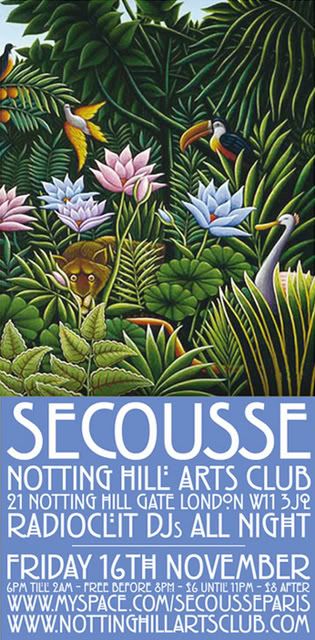
[Club poster for Secousse, previously discussed here]


Once, what seems to be an awful many years ago now, the scene was about "exploring" the self-made music of ex-colonial subjects and bringing it up to western attention, in contrast with the exoticising old world music. Then the DJ's involved starting making their own music which imitated or referenced the music they'd previously transmitted, sometimes in "collaboration" with third-world artists. At the lowest end of this there are offensive caricatures, like the ones Rachel so eloquently criticise in this post, but even then the people involved try to put themselves on the same level as the people involved - they're (sarcastically, perhaps, I guess) trying to be colonised subjects.

But now, it seems, the path is open for the colonised subjects to disappear completely, like they have in tiki revival. (The word "tikitech" is from a Reader comment by Wayne.) Rather than reference some cultural manifestation from the third world, they reference a kitchy european or american fantasy of third world culture, or often not even that, merely an empty paradise, exotica for exotica's sake. Tiki revival has its ancient, mystical statues, and global ghettotech has its safari imagery - the Lion King, Madagascar, lion costumes. Animals abound but there are absolutely no people. This, of course, happily mirrors the simultaneous decrease of third world musicians in the actual music. The issue lies deeper than just some pictures.

For me, as I stated in my comment to Rachel's post, the self-consciously colonial imagery is a lot worse than the clumsy caricatures. As the tiki example shows, seriousness is but a small step away, and though it may be (in Rachel's words) "snarky / cheeky / hitorical / self-referencial" now it's still being used, and somehow appreciated by the creators and listeners. To take up a recurring theme in this post again: there's a very thin line indeed between being privileged and self-referentially pretending to have a colonial mindset, and actually having one in the midst of that privilege.